The Iron Body Letters — Letter Five

Start with Letter One here <<==

The Beginning of the Path

The Iron Body Letters — Letter Four

Start with Letter One Here <<==

The Path Beneath the Art

Warriors –

Every sincere search eventually arrives at a place where another technique is no longer the answer.

For a long time, that realization can feel unsettling.

The instinct is to continue searching outward—to attend another seminar, study another system, collect another method, or hope that somewhere, someone possesses the missing piece.

I understand that instinct because I have lived it.

For many years, I believed the next breakthrough would come from discovering something I did not yet know. What I did not understand was that the most important discoveries are rarely found by adding something new. More often, they emerge when everything we have learned begins to reveal the same underlying truth.

Looking back over nearly four decades of practice, I no longer see separate systems.

I no longer see Japanese martial arts over here and Chinese internal arts over there. I no longer separate standing practice from strength training, breathing from movement, or physical conditioning from martial skill.

I see one conversation unfolding through many different languages.

Every meaningful teacher I encountered was pointing toward the same destination.

Some emphasized posture.

Others emphasized breath.

Some cultivated stillness.

Others cultivated movement.

Some developed tendon strength.

Others developed internal pressure.

Their methods differed because their traditions differed.

Their principles did not.

Slowly, almost without realizing it, I stopped collecting methods.

I began searching for principles.

Methods belong to cultures.

Principles belong to reality.

Methods evolve.

Principles endure.

That realization changed not only the way I trained, but the way I understood martial arts themselves. I no longer believed that the purpose of training was simply to accumulate greater technical knowledge. Nor did I believe that the purpose was merely to become stronger, faster, or more physically capable.

Those qualities matter.

But they are not the destination.

They are the natural consequence of something deeper. The true work of martial practice is the lifelong cultivation of the practitioner. Everything else grows from that foundation.

When the practitioner becomes more powerful, technique changes.

When the practitioner becomes more connected, power changes.

When the practitioner becomes more resilient, endurance changes.

When the practitioner becomes more aware, timing changes.

When the practitioner becomes more fully integrated, the entire art changes.

Nothing has been added.

Everything has been transformed.

For many years I struggled to explain this to my students.

I taught standing practice.

I taught breathing.

I taught isometrics.

I taught Martial Qigong.

I taught Iron Silk.

I taught body conditioning.

I taught classical kata.

Each method revealed another piece of the puzzle.

Each helped students develop a particular quality.

Yet something continued to trouble me.

The pieces remained scattered.

Students learned methods.

What I truly wanted to teach was the path. Only much later did I realize that I had not spent decades creating separate courses. I had been describing different rooms within the same house.

The house itself had remained invisible.

As the years passed, the architecture gradually revealed itself. I could finally see the deeper order that had always been present.

Structure before strength.

Connection before power.

Presence before precision.

Cultivation before expression.

These were not isolated lessons.

They were enduring principles.

The methods simply gave those principles a place to live. At some point I needed a way to describe that path. Not because I believed I had invented something new.

Quite the opposite.

Because I finally recognized something that had been quietly present throughout my entire journey.

One phrase continued returning to me.

Again and again.

It became the compass by which I evaluated every exercise, every drill, every tradition, and every hour of practice.

Build the Body Beneath the Art.

Not because the body is more important than the art. But because every art is ultimately limited—or liberated—by the body that expresses it.

The body is not the destination.

It is the living foundation upon which the art is built.

If the foundation is weak, the art remains constrained.

If the foundation is patiently cultivated, the art continues to deepen for a lifetime.

That simple realization has become the guiding philosophy behind everything I teach.

It is why I no longer ask whether a method belongs to one style or another.

I ask whether it helps cultivate the practitioner.

Does it develop structure?

Does it deepen connection?

Does it foster resilience?

Does it encourage awareness?

Does it prepare the body to express the art more completely?

If the answer is yes, it belongs.

Everything else is simply a matter of language.

Over the years, many students asked me where they should begin.

Should they start with standing?

With breathing?

With isometrics?

With Martial Qigong?

With Iron Silk?

With strength training?

My answer gradually became clear. The question was never where to begin. The question was how all of these practices belonged together.

That realization eventually led me to organize everything I had learned into a single developmental path—not another collection of courses, but a coherent framework through which these principles could be practiced, embodied, and lived.

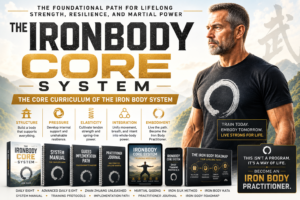
I call that framework the Iron Body Core System.

Not because it contains every answer.

No system ever could.

But because it represents the clearest expression I have yet found of the path I have been walking for nearly forty years.

If these letters have resonated with you, perhaps it is because you have been asking many of the same questions.

If so, I would be honored to continue that search together.

The Iron Body Core System is simply my invitation to walk that path with me.

Not as followers.

Not as imitators.

But as fellow practitioners committed to the lifelong work of cultivation.

The masters never asked us to become copies of themselves. They invited us to seek what they sought. That invitation remains before us today.

May we have the patience to accept it.

May we have the discipline to continue it.

And may we never forget that the highest purpose of martial practice is not merely to master techniques.

It is to become the kind of human being capable of expressing them.

Stronger Every Day,

Jon Haas, The Warrior Coach

Read Letter 5 here <<==

The Iron Body Letters — Letter Three

Seek What They Sought

“Do not seek to follow in the footsteps of the wise; seek what they sought.”
— Matsuo Bashō

Warriors –

There are certain sentences that enter your life quietly. You read them once, appreciate their beauty, and move on.

Then, years later, after enough practice, enough mistakes, and enough honest reflection, you discover that those same words have been patiently waiting for you all along.

For me, this was one of those sentences.

For many years I believed my goal was to follow the great masters.

I studied their techniques.

I practiced their kata.

I admired their accomplishments.

I tried to understand how they moved.

But, eventually I realized that imitation was never the goal. The goal was understanding. Not understanding what they did. Understanding what they were searching for.

That realization changed the direction of my entire journey.

I stopped asking why Sagawa moved the way he moved.

I began asking what he had discovered.

I stopped asking why Wang Xiangzhai devoted so much of his practice to standing meditation.

I began asking what truth he believed standing could reveal.

I stopped asking why the old masters returned again and again to posture, breathing, structure, patience, and seemingly simple exercises.

I began asking why these same principles kept appearing across traditions that had never met one another.

Different countries.

Different languages.

Different histories.

Different methods.

Yet somehow they continued arriving at remarkably similar conclusions.

That cannot be an accident. It suggests that beneath every method lies something deeper. A principle waiting to be discovered.

The longer I trained, the less interested I became in collecting methods.

I wanted to understand the principles that gave birth to those methods.

Methods belong to styles.

Principles belong to reality.

Styles evolve.

Methods change.

Principles endure.

That realization liberated me.

I no longer felt compelled to choose between Japanese martial arts and Chinese internal arts. Between old-time strength training and modern exercise science. Between standing meditation and strength development.

If they revealed the same principle, they belonged together.

The principle was more important than the method.

Many years after this realization began taking shape, I encountered a statement from Yukiyoshi Sagawa that seemed to express in a few direct sentences what had taken me decades to understand.

“People who think they can ignore training their bodies and only work on techniques are amateurs. They don’t know anything. Actually, if you can’t prepare your body properly, you have no hope of ever perfecting your technique.”

When I first read those words, they sounded severe.

Today they sound compassionate.

Sagawa was not diminishing technique. He was reminding us that technique can never rise above the quality of the practitioner expressing it.

Technique is not where mastery begins. It is where mastery becomes visible.

Everything else happens long before anyone is watching.

That is why the greatest lessons are often hidden inside the simplest practices.

Standing quietly.

Breathing attentively.

Moving with awareness.

Returning every day.

These things rarely impress spectators.

Yet they transform practitioners.

Looking back over forty years of training, I no longer believe I have spent my life studying different martial arts.

I believe I have spent my life following a single question through many different traditions.

Each teacher offered a different path.

Each tradition spoke a different language.

Yet all of them pointed toward the same mountain.

Not the perfection of technique.

The cultivation of the human being. I suspect that is what the masters were really seeking. And I believe that search is still worthy of our lives today.

The longer I reflect on these things, the less interested I become in preserving methods simply because they are old, or adopting new methods simply because they are modern.

Age has very little to do with truth.

What matters is whether a method reveals an enduring principle.

The responsibility of every generation is not merely to preserve the forms it has inherited.

It is to rediscover the principles that gave those forms life in the first place.

That is why I no longer ask whether an exercise is Japanese or Chinese.

Ancient or modern.

Traditional or scientific.

I ask only one question.

What truth does it reveal about the cultivation of the practitioner? If that truth is genuine, then it deserves to be preserved. If it helps us become stronger without becoming rigid…

More resilient without becoming hardened…

More capable without becoming arrogant…

Then it belongs on the path.

Perhaps that is what Bashō was inviting us to understand all along.

The masters never asked us to become copies of themselves.

They invited us to continue the search.

Not to walk in their footsteps…

But to seek what they sought.

That search has become the work of my life.

Tomorrow, I’d like to share where that search ultimately led me—and why I believe every meaningful method I have ever studied is part of a single path that I now simply describe as building the body beneath the art.

Stronger Every Day!

Jon Haas, The Warrior Coach

Read Letter 4 here <<==

The Iron Body Letters — Letter Two

The Invisible Practice

Warriors –

Every martial artist practices two arts.

One can be seen.

The other cannot.

The visible art is familiar to all of us. It is found in punches and throws, in kata and footwork, in timing and distance, in locks, strikes, and countless hours spent refining movement. It is the art that instructors correct, that spectators admire, and that students devote years to mastering.

The invisible art is quieter.

It reveals itself only gradually, almost reluctantly, through years of sincere practice. It is the cultivation of qualities that cannot be photographed or measured, yet determine the character of every movement we make. It is the patient development of structure, balance, awareness, connection, resilience, presence, and integrity.

The longer I train, the more convinced I become that the visible art has always been shaped by the invisible one.

When we watch a great practitioner, we are naturally drawn to what we can see. We admire the effortless throw, the perfectly timed strike, the calm precision with which every movement unfolds. We assume that what we are witnessing is extraordinary technique.

Perhaps it is.

But perhaps we are witnessing something much deeper.

Perhaps we are seeing the visible expression of decades of invisible cultivation.

A magnificent tree does not stand because its branches have been carefully polished.

It stands because unseen roots have continued to deepen beneath the surface for many years. The strength of the tree is not determined by what is visible above the ground. It is determined by what has quietly developed below it.

Martial practice follows the same law.

Technique is the branch.

Cultivation is the root.

One cannot flourish for long without the other.

For much of my own journey, I devoted my attention to the branches. I believed that another technique, another principle, another kata, or another seminar would eventually reveal the understanding I was seeking.

Some of those experiences were invaluable.

Many simply expanded my collection of knowledge.

Only with time did I begin to recognize a humbling truth.

The techniques themselves had never been the destination.

They were invitations.

Every technique was quietly asking something of me long before it ever asked anything of an opponent.

A punch was asking whether my body could remain connected from the ground to the fist.

A throw was asking whether I could maintain balance while taking another person’s balance.

A lock was asking whether I could cultivate sensitivity before relying on force.

Even standing still was asking whether I possessed the patience to remain present when nothing appeared to be happening.

The techniques were never simply teaching me how to move.

They were asking me to become someone capable of moving in that way.

Looking back, I realize that every meaningful lesson in martial arts has carried this same invitation.

Not merely to acquire another skill.

But to undergo another transformation.

There is an important distinction between knowing a principle and embodying it.

Knowledge lives in the mind.

Embodiment lives in the whole person.

A principle that exists only as an idea remains fragile. Under pressure it is easily forgotten. But when that same principle has been patiently cultivated through thousands of quiet repetitions, it no longer requires conscious thought. It has become part of your nature.

This is why the greatest practitioners often appear so ordinary.

Their movements are rarely dramatic.

They do not force technique.

They do not display effort.

They simply express what they have become.

Technique is no longer something they perform.

It is something they embody.

For many years I divided my training into separate compartments. Strength belonged in one place. Standing practice belonged somewhere else. Breathing was something different. Mobility belonged to another discipline. Martial technique belonged inside the dojo.

Eventually I realized that these distinctions existed only in my own thinking.

The body recognizes no such divisions.

It simply expresses whatever it has become.

Seen in this light, every meaningful practice serves the same purpose.

Standing is not merely standing.

Breathing is not merely breathing.

Strength training is not merely strength training.

Each becomes another opportunity to cultivate the practitioner.

Each becomes another way of tending the roots rather than merely polishing the branches.

This realization transformed the way I evaluate every exercise, every drill, and every hour I spend training.

I no longer ask, “Will this make me stronger?”

Nor do I ask, “Will this improve my technique?”

I ask a different question.

Will this help me become the kind of practitioner my art is asking me to become?

I have come to believe that this is the invisible practice.

It is the work that receives little recognition because so much of it occurs beyond the reach of the eye. It cannot be measured by rank, trophies, demonstrations, or applause.

Yet it quietly determines everything the world will eventually see.

The visible art will always attract our attention.

The invisible art will always determine its depth.

Stronger Every Day,

Jon Haas, The Warrior Coach

P.S. In the next letter, I’d like to share a lesson from Yukiyoshi Sagawa that illuminated this truth in a profound way. More importantly, I’d like to explore why the greatest masters of every tradition were never simply preserving techniques—they were searching for principles that transcended style, culture, and even time itself.

Read Letter 3 here <<==

The Iron Body Letters — Letter One

The Beginning of a Different Question

Warriors –

Over the past four decades, I’ve had the privilege of studying with remarkable teachers, training alongside extraordinary martial artists, and spending thousands of hours on the mats, in the dojo, and in the gym.

I’ve devoted much of my life to understanding one simple question: Why do some martial artists continue getting stronger, more capable, and more powerful as they age… while others slowly decline despite years of dedicated practice?
It’s a question that has fascinated me for decades.

There comes a point in every martial artist’s life when technique is no longer enough.

The movements remain the same, yet the body begins to change. Recovery takes longer. Old injuries linger. Strength becomes less dependable. Techniques that once felt effortless begin to require conscious effort. Many practitioners respond by searching for another kata, another seminar, another drill, or another secret hidden somewhere just beyond their current understanding.

For many years, I did exactly the same thing.

I believed that every limitation in my martial art could be overcome by learning another technique.

If my strikes lacked power, I searched for a better striking method.

If my throws failed, I refined my mechanics.

If my timing was inconsistent, I assumed I simply needed more practice.

Like countless martial artists before me, I devoted myself to collecting knowledge. I studied classical kata. I trained under remarkable teachers. I filled notebooks with principles, observations, and training ideas. Every new lesson felt like another step toward mastery.

Some of those lessons transformed my understanding.

Many simply added to my collection.

It took me nearly four decades to recognize that I had been asking the wrong question.

The question was never, “What technique should I learn next?”

The deeper question was, “What kind of person must I become in order to express the art at its highest level?”

That question quietly changed everything.

As the years passed, I began noticing something that I could not easily explain.

I met practitioners whose technical knowledge seemed almost limitless. Their kata were beautiful. Their movements were precise. They could explain every principle in extraordinary detail. Yet when they moved, something felt incomplete. The techniques were correct, but they lacked a quality that cannot be measured by angles or mechanics alone.

Then I met others whose movements appeared almost ordinary.

They did not rely on speed.

They did not rely on muscular strength.

They did not overwhelm you with complexity.

Yet the moment you touched them, you encountered something entirely different…

They were rooted without becoming rigid.

Relaxed without becoming weak.

Powerful without appearing forceful.

There was a unity throughout their entire body that made every movement feel inevitable, like the force of gravity itself.

At first I believed I was witnessing superior technique.

Eventually I realized I was witnessing something much deeper.

I was witnessing the expression of a lifetime of cultivation.

That realization forced me to reconsider everything I thought I understood about martial arts. Perhaps the true purpose of training was never simply to accumulate techniques. Perhaps techniques were only the visible surface of something much deeper. Perhaps every kata, every drill, every exercise, and every hour spent on the training floor was pointing toward the same destination.

Not the perfection of movement.

The cultivation of the practitioner.

That simple distinction changed the direction of my life.

For years I believed I was studying martial arts.

Looking back, I now understand that martial arts were quietly studying me.

Every challenge demanded greater patience.

Every failure revealed another weakness.

Every success hinted at a deeper level still waiting to be discovered.

Without realizing it, I was not simply learning how to punch, throw, lock, or strike.

I was being shaped.

The older I become, the more convinced I am that this is the true purpose of martial practice.

Not merely to become technically proficient.

But to become the kind of human being capable of expressing those techniques with integrity, resilience, wisdom, and effortless power.

Everything else is simply a method.

Over the coming letters, I’d like to share the philosophy that gradually emerged from this lifelong search. It is not a philosophy I invented, nor one that belongs to any single style or tradition. Rather, it is a way of understanding martial development that I discovered repeated again and again throughout the Japanese arts, the Chinese internal traditions, old-time physical culture, and modern strength training.

Different methods.

Different cultures.

Different languages.

Yet all quietly pointing toward the same enduring truth.

I believe the highest purpose of martial training is not merely to perfect technique.

It is to cultivate the practitioner.

And once that changes, everything else begins to change as well.

Stronger Every Day,

Jon Haas, The Warrior Coach

P.S. In the next letter, I’d like to explore a realization that took me many years to fully understand: technique and the body are not separate pursuits. One is simply the visible expression of the other. Once I saw that clearly, I could never look at martial training the same way again.

Read Letter 2 here <<==

Can Isometrics Really Burn Fat?

The Surprising Truth About One of the Most Underrated Fat-Loss Methods Ever Created

When most people think about burning fat, they imagine one thing: Cardio.

Running.
Cycling.
Rowing.
Jumping rope.

Or maybe they think of brutal HIIT workouts that leave them gasping for air and lying on the floor questioning their life choices.

But what if there was another way?

What if one of the oldest strength-training methods in existence could help you burn fat, build muscle, protect your joints, and improve your martial arts performance at the same time?

That’s where isometric training comes in.

And despite what many people believe, isometrics can be a surprisingly powerful fat-loss tool.

The key is understanding how they work.


The Biggest Myth About Fat Loss

Many people assume that fat loss only happens during exercise.

That’s not true.

Fat loss occurs when your body uses more energy than it consumes over time.

Exercise contributes to that process, but what matters even more is what happens after the workout.

This is where isometrics become incredibly interesting.

Because unlike traditional cardio, isometrics can create a unique combination of:

  • High muscular tension
  • Increased metabolic demand
  • Greater muscle preservation
  • Elevated post-workout calorie burn
  • Improved insulin sensitivity

All of which support fat loss.


Why Isometrics Demand More Energy Than You Think

At first glance, an isometric exercise doesn’t seem very intense. After all, you’re not moving. But internally, your body is working incredibly hard.

When you hold a deep horse stance…

When you maintain a wall sit…

When you drive against an immovable object…

Thousands of muscle fibers are firing simultaneously. Your nervous system recruits additional motor units to maintain force production.

Blood flow becomes partially restricted.

Metabolic byproducts begin accumulating.

The body is forced to work harder and harder simply to maintain the position.

This creates a surprisingly large energy demand.

Research has consistently shown that isometric contractions increase heart rate, oxygen consumption, and metabolic activity.

In other words:

Just because you’re not moving doesn’t mean you’re not working.


Research: Isometrics Increase Metabolic Demand

Studies examining sustained isometric contractions have demonstrated significant increases in:

  • Heart rate
  • Oxygen consumption
  • Blood lactate levels
  • Energy expenditure

Researchers have found that high-intensity isometric contractions can produce cardiovascular responses similar to traditional exercise.

This is one reason why activities like:

  • Wall sits
  • Horse stance training
  • Plank variations
  • Isometric squat holds
  • Overcoming isometrics

Often leave practitioners sweating heavily despite never taking a single step.

The body perceives these exercises as hard work because they are hard work.

The tension is real.

And tension requires energy.


Muscle Is the Engine of Fat Loss

One of the biggest problems with traditional fat-loss programs is that they often sacrifice muscle.

People lose weight.

But they also lose strength.

They lose athleticism.

They lose power.

And eventually their metabolism slows down.

Isometric training helps solve this problem.

Numerous studies have demonstrated that isometric contractions can build strength and preserve muscle mass effectively.

Why does this matter?

Because muscle tissue is metabolically active.

The more muscle you maintain while dieting, the easier it becomes to burn fat and keep it off.

This is especially important for martial artists and men over 40.

As we age, muscle loss accelerates.

Every year that passes makes preserving strength more important.

Isometrics help you hold onto the very tissue that keeps your metabolism running strong.


The Afterburn Effect

One of the hidden benefits of hard isometric training is Excess Post-Exercise Oxygen Consumption (EPOC).

Often called the “afterburn effect.”

Following intense exercise, the body continues consuming oxygen and expending energy as it recovers.

This process can continue for hours.

The harder the muscular effort, the greater the recovery demand.

High-tension isometric training creates:

  • Nervous system fatigue
  • Muscular fatigue
  • Tissue adaptation demands

All of which require energy to recover from.

That means your body continues burning calories after the workout is over.


Why Isometrics Are Perfect for Older Warriors

Traditional fat-loss programs often create a frustrating cycle.

You want to lose weight.

So you do more cardio.

Your joints start hurting.

Your recovery suffers.

Your motivation drops.

Then you stop.

Isometrics offer a different path.

Because there is little or no impact.

No pounding.

No repetitive joint stress.

No endless miles of running.

Instead, you can create intense muscular effort while protecting the knees, hips, ankles, and spine.

For practitioners over 40, this can be a game changer.

You can continue training hard without accumulating the wear and tear that often comes with traditional conditioning methods.

Why Most Fat-Loss Programs Fail Martial Artists Over 40

At 25, you can get away with almost anything.

Miss sleep.

Train hard every day.

Run miles on concrete.

Push through nagging injuries.

Your body absorbs the punishment and somehow keeps moving forward.

But after 40, the rules change. Unfortunately, most fat-loss programs don’t. They still tell you to:

  • Run more.
  • Do more cardio.
  • Train harder.
  • Burn more calories.
  • Push through fatigue.

And for many martial artists, that’s exactly where things start falling apart. The knees begin aching. The hips get tight. The lower back stiffens. Recovery slows down. Training becomes inconsistent.

Then something even worse happens: You start losing the very qualities that made you a martial artist in the first place.

  • Strength.
  • Power.
  • Stability.
  • Balance.
  • Structure.

Instead of becoming leaner and stronger, you become lighter—but weaker. This is one of the biggest mistakes aging martial artists make. They chase weight loss while sacrificing performance.

But the goal isn’t simply to weigh less.

The goal is to build a body that can still move, fight, train, and perform.

A body that remains capable.

A body that remains resilient.

A body that remains powerful.

This is where isometric training shines.

Rather than breaking the body down through endless impact and repetitive motion, isometrics strengthen the very structures that tend to deteriorate with age:

  • Tendons
  • Ligaments
  • Stabilizer muscles
  • Postural chains
  • Connective tissue networks

At the same time, they help preserve muscle mass, maintain strength, improve joint integrity, and increase metabolic demand. In other words: You aren’t just burning calories. You’re rebuilding the foundation.

That’s why many practitioners discover something surprising after several months of consistent isometric training:

They not only look better…

They move better.

Their stances feel stronger.

Their balance improves.

Their joints hurt less.

Their techniques become more efficient.

And perhaps most importantly—

They begin feeling like martial artists again.

Not because they’re younger.

But because they’re finally training in a way that supports longevity instead of fighting against it.


The Martial Arts Advantage

This is where things get really interesting. Most forms of exercise burn calories. But not all forms of exercise improve martial performance. Isometric training does both.

The same tension that helps build strength and increase metabolic demand also develops:

  • Structural integrity
  • Rooting
  • Stability
  • Power transfer
  • Tendon strength
  • Body control

The exact qualities martial artists need.

A deep horse stance isn’t just burning calories.

It’s strengthening the legs.

Building posture.

Developing mental toughness.

Training alignment.

Improving fighting structure.

This means every minute of training serves multiple purposes.

You become leaner.

You become stronger.

You become harder to move.

And you become more dangerous.


The Secret Weapon: Overcoming Isometrics

If your goal is maximum fat loss and strength development, overcoming isometrics deserve special attention. These involve pushing or pulling against an immovable object with maximal effort.

Examples include:

  • Pulling against a fixed strap
  • Pushing against safety pins
  • Driving into a wall
  • Pressing against an immovable bar

The muscular recruitment during these efforts is enormous. Nearly every available motor unit is called into action. The result is a tremendous neurological and metabolic stimulus.

Few training methods provide more return on investment.

A 10-second maximal overcoming isometric can leave even experienced athletes breathing hard.


A Simple Fat-Burning Isometric Circuit

Try this:

  1. Horse Stance – 90 sec
  2. Low Push-Up Hold – 45 sec
  3. Lunge Hold – 45 sec/side
  4. Plank – 60 sec
  5. Rotational Isometric – 30 sec/side
  6. Overcoming Row – 20 sec
  7. Overcoming Press – 20 sec
  8. Dantien Breathing – 60 sec

Protocol: Rest 60 seconds. Repeat 3-5 rounds.

The entire workout takes less than 20 minutes. Yet most people will finish drenched in sweat.

More importantly – Your muscles, connective tissue, cardiovascular system, and nervous system will all have been challenged simultaneously.


The Real Secret: Consistency

Can isometrics burn fat?

Absolutely.

But the real magic happens when you practice them consistently.

Not once a week.

Not when you feel motivated.

Daily.

Even 10 minutes per day can produce remarkable results when performed consistently over months and years.

This is how warriors were built long before treadmills existed.

Through tension.

Discipline.

Structure.

And daily practice.


Final Thoughts

If you’re looking for a fat-loss method that also builds strength, protects your joints, enhances martial performance, and helps you stay powerful as you age, isometric training deserves a place in your routine.

The beauty of isometrics is that they don’t force you to choose between conditioning and strength.

You get both.

You don’t have to sacrifice your joints to burn fat.

You don’t have to spend hours doing cardio.

You simply learn how to generate tension correctly and apply it consistently.

That’s where real transformation begins.

Ready to Experience the Power of Isometric Training?

The truth is that most people only scratch the surface of what isometric training can do.

Inside The Isometric Warrior Training Guide, you’ll discover the complete system for using isometrics to build real-world strength, develop tendon power, improve martial performance, increase resilience, and create a body that grows stronger—not weaker—with age.

You’ll learn:

  • Yielding Isometrics
  • Overcoming Isometrics
  • Rotational Isometrics
  • Ancient martial applications
  • Fat-burning training protocols
  • Strength-building blueprints
  • Joint-friendly workouts for practitioners over 40

If you’re ready to unlock one of the most powerful—and misunderstood—training methods ever developed, The Isometric Warrior Training Guide is your next step.

Because the goal isn’t just to lose fat.

It’s to build a body that remains strong, capable, and dangerous for life.

The Complete Path to Lifelong Martial Strength

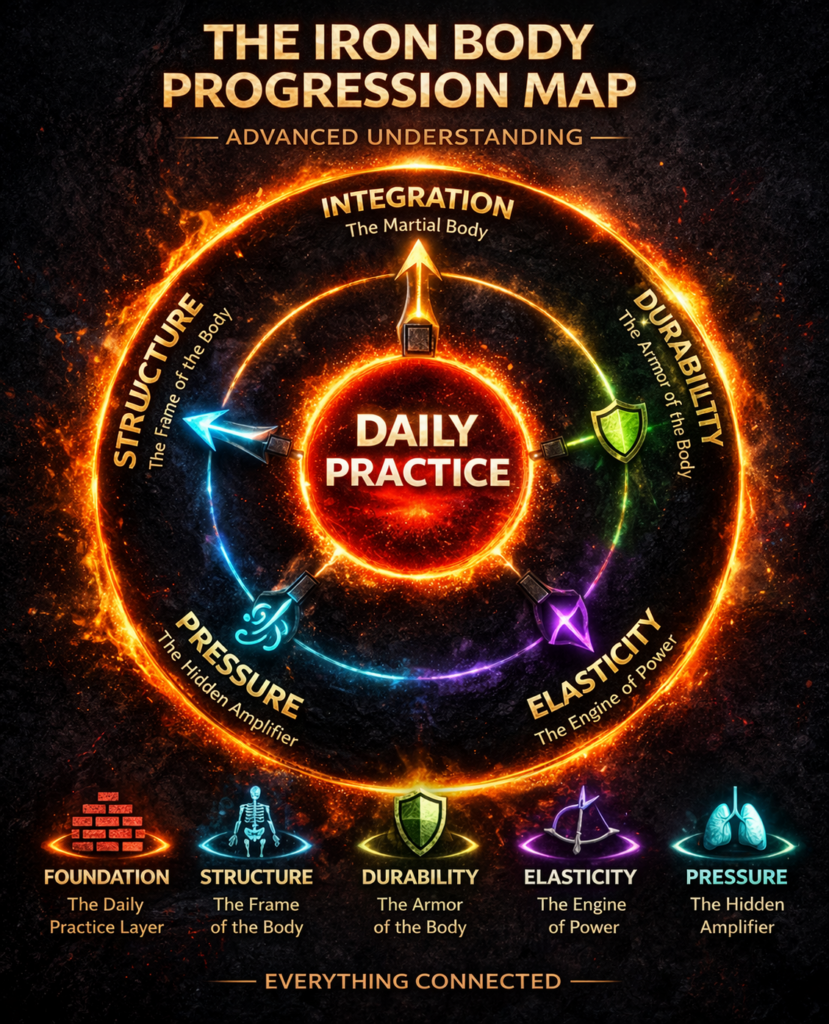
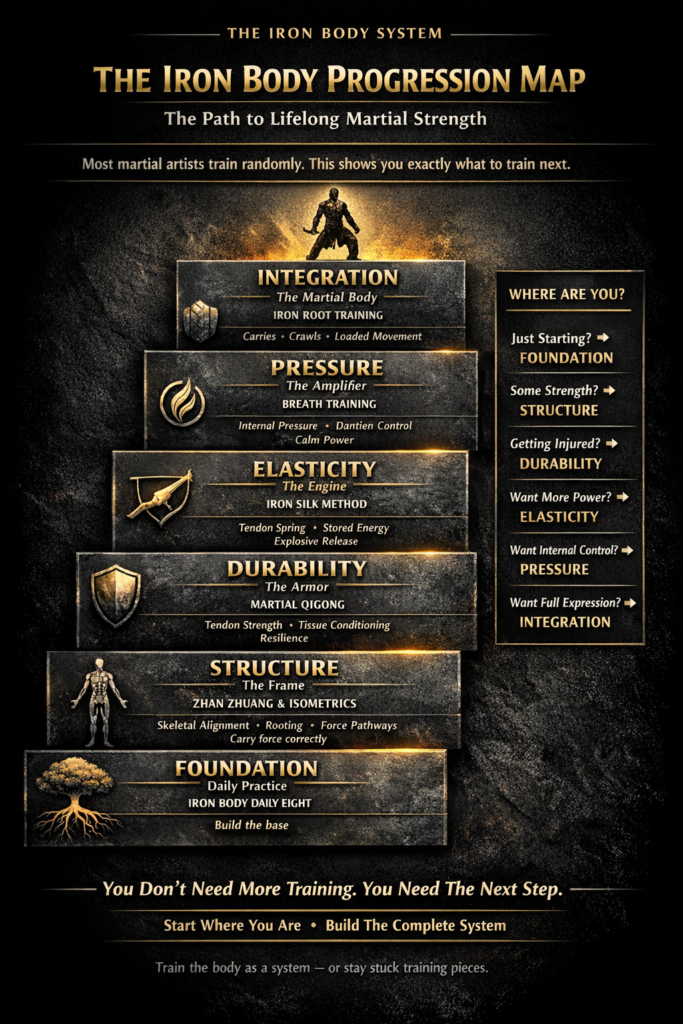
THE IRON BODY PROGRESSION MAP

The Complete Path to Lifelong Martial Strength


The Iron Body Is Not Built All At Once

It Is Built In Layers

There comes a moment in every serious martial artist’s life where something doesn’t quite add up anymore.

It doesn’t happen during training. In fact, during training, everything can feel fine. You’re moving, you’re sweating, you’re working. But afterward… when you sit down, when your body settles, that’s when you start to notice it.

Your understanding is deeper than it’s ever been. Your timing is better. Your awareness is sharper. You see things now that you never saw before.

And yet your body doesn’t respond the way it used to.

Your strikes require more effort. Your structure doesn’t feel as stable under pressure. Recovery takes longer than it should. And the most frustrating part is this—you’re still training. Maybe harder than ever.

So what’s the problem?

The truth is, you’re not losing skill.

You’re losing your ability to express it.

Your mind still understands exactly what to do, but your body no longer has the capacity to carry it out the way it once did. And this has nothing to do with age, effort, or discipline.

It has everything to do with how you’ve been training.


The Real Problem Is Fragmentation

Most martial artists train in pieces.

They build a little strength here, add some conditioning there, work their techniques, maybe sprinkle in mobility or flexibility work. On the surface, it looks complete. It feels like they’re covering all the bases.

But they’re not.

They’re training parts of the body… instead of training the body as a system.

Over time, this creates a kind of internal disconnect. Strength develops without structure. Durability improves without elasticity. Breath is trained, but never fully integrated into movement. And slowly, almost invisibly, the body starts to lose its cohesion.

Power begins to leak. Movement becomes stiff. Effort increases where it used to be effortless.

Because the body doesn’t function in isolated pieces. It functions as an interconnected whole.

This is what the old masters understood—deeply, physically, not just intellectually. They weren’t chasing strength or conditioning as separate qualities. They were developing the body itself. They were building a system.

That’s the idea behind the Iron Body.

And it’s the reason the Iron Body Progression Map exists.


A Map That Shows You What To Do Next

Most people don’t need more information.

They need direction.

They need to know where they are, what they’re missing, and what comes next.

The Iron Body Progression Map gives you that.

It’s not just a concept. It’s a structure you can follow. A way to rebuild your body layer by layer, so that everything begins to work together again instead of fighting against itself.

You can think of it as a ladder. Each step supports the one above it. Skip a step, and everything becomes unstable. Follow it in order, and something powerful begins to happen—the body starts to reconnect.


Foundation: Where Everything Begins

At the base of the system is daily practice. This is the Iron Body Daily Eight.

This is where most people go wrong, because it doesn’t look impressive. It’s not intense. It doesn’t leave you exhausted. But that’s exactly why it works.

This layer teaches you how to hold your body correctly. It develops alignment, awareness, and a kind of quiet control over your nervous system. Your posture improves. Your breathing begins to settle. You start to feel your body as a connected whole rather than a collection of parts.

Without this layer, everything else you do sits on unstable ground. No matter how strong or skilled you become, something always feels off. But once this foundation is in place, everything above it has something solid to build on.

👉 If you don’t already have a structured daily practice, this is exactly what the Iron Body Daily Eight Mini-Course was designed to give you—a simple, guided starting point you can implement immediately.


Structure: Building the Frame

Once the foundation is established, the next step is structure.

This is where practices like Zhan Zhuang and isometric training come in. Now you’re no longer just aware of your body—you’re organizing it. You’re learning how to stack the skeleton, how to root into the ground, and how to create clear pathways for force to travel through your body.

This changes everything.

Instead of feeling loose or disconnected, you begin to feel supported. Stable. Grounded. Your body starts to behave like a unified structure rather than a series of moving parts.

Most people try to generate power before they build structure. That’s why their power never holds up under pressure. Because without structure, force has nowhere to go. It collapses.

Structure is what allows power to exist in the first place.

👉 This is why foundational isometric work and standing training are emphasized so heavily inside the system—they’re not “extra work”… they are the work.


Durability: Strengthening the Tissue

With structure in place, the next layer is durability.

Now you begin strengthening the actual material of the body—the tendons, fascia, connective tissue, and even the bones. This is where Martial Qigong comes in.

At this stage, the body starts to feel different. Joints that used to ache begin to settle down. The constant sense of wear and tear starts to fade. You don’t just feel strong—you feel resilient.

There’s a density to your body now. A kind of quiet toughness that doesn’t rely on tension.

This is what allows you to train consistently over time without breaking down. It’s what separates someone who trains hard for a few years from someone who can train for decades.

👉 This is the layer most modern training completely ignores—which is exactly why systems like Martial Qigong become so important as you progress.


Elasticity: The True Source of Power

Once the body is structured and durable, something new becomes possible.

Now you can develop elasticity.

This is where real martial power begins to emerge.

Through methods like Yi Jin Jing and the Iron Silk Method, you train the tendons to behave like springs. Instead of forcing movement with muscular effort, you begin to store and release energy naturally.

This is where things start to feel almost surprising.

Strikes become heavier, but require less effort. Movement becomes lighter, but more effective. The body begins to generate power without you having to consciously push for it.

This is the difference between forcing power and having power.

👉 This is where the Iron Silk Method fits into the system—developing the kind of spring-like power most martial artists never access.


Pressure: The Hidden Amplifier

At this point, everything is in place—but it still needs to be connected internally.

That’s where breath comes in.

Breath is what ties the entire system together. It creates internal pressure. It stabilizes the body from the inside out. It allows force to move through the body in a way that is controlled, efficient, and calm.

Without breath, everything remains mechanical.

With breath, everything becomes alive.

You’re no longer just moving your body—you’re driving it from within.


Integration: The Martial Body

The final layer is integration.

This is where everything you’ve built is tested and expressed through real movement—carries, crawls, loaded patterns, and martial application.

This is where strength becomes usable. Where structure becomes dynamic. Where power becomes something you can apply under pressure without thinking about it.

This is what it means to have a martial body.

Not just strength. Not just technique.

But a body that can express both—effortlessly.


Why This Changes Everything

Once you understand this map, your entire approach to training shifts.

You stop asking random questions like, “What workout should I do today?”

And you start asking a much more important question:

“What layer am I missing?”

That question gives you direction. It removes confusion. It allows you to train with purpose instead of guessing.

And more importantly, it prevents you from wasting years developing one quality while neglecting the others.


Where Are You Right Now?

If you’re honest with yourself, you already know where you are.

Maybe you’re just starting and need to build a foundation. Maybe you’re strong, but unstable. Maybe your body feels worn down and needs durability. Or maybe you’re chasing power, but haven’t yet developed the elasticity that makes it effortless.

Where you are determines what you should train next.


The Final Truth

You don’t need more intensity.

You don’t need more random training.

You don’t need to push harder.

You need to train the right layer, at the right time, in the right order.

That is how the Iron Body is built.


Start Here

If you want to begin the process the right way, start with the foundation.

The Iron Body Daily Eight is where everything begins. It’s simple, but it’s not easy. It requires attention, consistency, and patience. But if you commit to it, it will change the way your body feels, moves, and performs.

From there, you build upward—structure, durability, elasticity, pressure, and finally integration.

And over time, something shifts.

You don’t just feel stronger.

You feel connected. Stable. Powerful.

Like your body is finally working the way it was meant to.

👉 The Iron Body Daily Eight is the entry point into this entire system.

– -Jon Haas, The Warrior Coach

The Third Type of Isometric Training Most People Never Learn

The Third Type of Isometric Training Most People Never Learn (Rotational Isometrics)

Most people think isometric training means one thing:

Holding still.

Planks.
Wall sits.
Horse stance.

And if they go a little deeper, they might discover overcoming isometrics—pushing or pulling against an immovable object.

But there is a third type of isometric training that almost nobody talks about.

And it’s the one that most closely resembles real martial power.

It’s called:

Rotational Isometrics


Why Most Strength Training Falls Short

Most strength training is linear.

Up and down.
Push and pull.

Even most isometric training is linear:

You hold a position.
Or you push in one direction.

But martial arts are not linear.

Punches rotate.
Throws spiral.
Grappling involves torque, pressure, and redirection.

Power doesn’t move in straight lines.

It moves in curves, spirals, and angles.

And if your training doesn’t reflect that…

Your strength won’t transfer.


What Are Rotational Isometrics?

A rotational isometric is when you create tension by resisting rotation or producing force in opposing directions.

Instead of holding still…

You are actively creating twisting force inside the body.

Examples include:

• resisting a band pulling you into rotation
• twisting into a stance without moving
• creating opposing forces between upper and lower body
• diagonal push/pull tension patterns
• rotational squat holds
• Dragon Coil Holds

The key idea:

You are not just holding position.
You are organizing force through the body.


What Rotational Isometrics Train

This is where things get interesting.


1. Fascial Chains (Not Just Muscles)

Rotational tension travels through the body in diagonal patterns.

This activates:

• anterior/posterior sling systems
• cross-body fascial lines
• spiral tension chains

These are the exact pathways used in:

• punching
• throwing
• takedowns
• weapon work


2. Internal Connection

Rotational isometrics teach the body how to:

• connect upper and lower body
• transmit force across the torso
• maintain structure during movement

This is what many internal arts call:

“whole-body power”


3. Torque and Pressure

Linear strength pushes.

Rotational strength twists and compresses.

This is what creates:

• heavy hands
• crushing grappling pressure
• destabilization of opponents


4. Anti-Rotation Stability

Ironically, training rotation improves your ability to resist rotation.

This is critical for:

• defending takedowns
• maintaining base
• staying balanced under pressure


Why This Is the Missing Link

Here’s the problem:

Most people train:

✔ Yielding (structure)
✔ Overcoming (force)

But they skip:

❌ Direction of force

So their strength exists…

…but it doesn’t transfer cleanly into movement.

Rotational isometrics fix that.

They teach the body how to:

organize force through angles


The Martial Connection

If you look at traditional systems:

• Tai Chi → silk reeling
• Bagua → circular walking
• Xing Yi → directional force
• Jujutsu → kuzushi (off-balancing)

They are all based on:

rotation and redirection of force

Rotational isometrics are the modern bridge into that training.

They make those principles:

• measurable
• repeatable
• physically trainable


How I Use Rotational Isometrics

Inside my system, rotational work comes after structure is built.

Because without structure, rotation becomes collapse.

Here’s how it fits:

Step 1 — Yielding Isometrics

Build structure and endurance

Step 2 — Overcoming Isometrics

Build force and power

Step 3 — Rotational Isometrics

Organize and apply that power


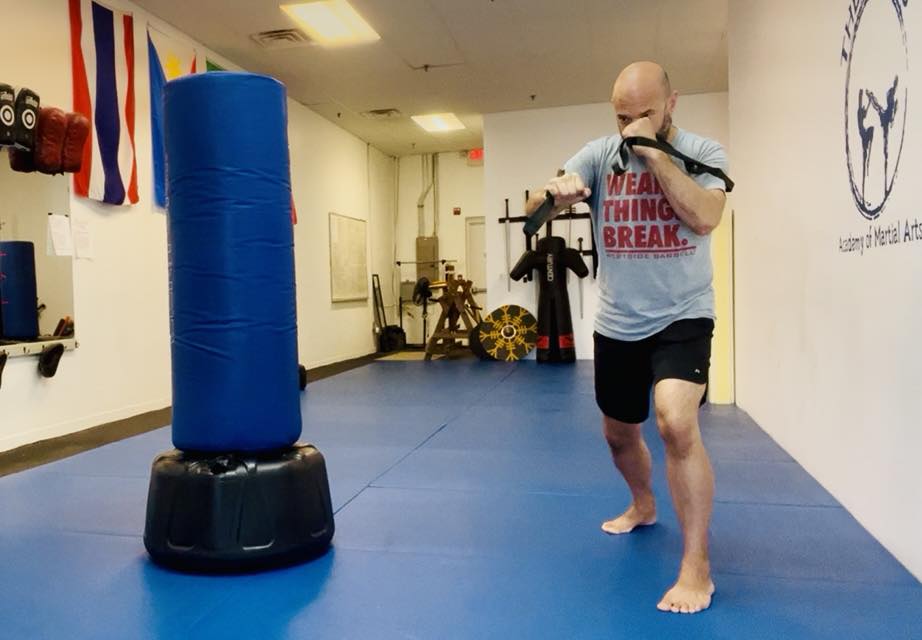
Example Drill — Diagonal Push/Pull

Set up:

• Attach a band or strap
• One hand pushes forward
• One hand pulls back
• Hips remain stable
• Spine tall

Hold for 30–45 seconds.

Focus on:

• creating tension through the torso
• breathing calmly
• feeling force travel from foot to hand

This is not a “hold.”

This is a force pattern.


Example Drill — Dragon Coil Hold

From a squat:

• rotate the torso
• maintain lower body alignment
• create opposing tension

This develops:

• spiral strength
• hip integration
• rotational power


Where Most People Go Wrong

They try to muscle the movement.

But rotational strength is not about squeezing harder.

It’s about:

• direction
• alignment
• connection

Too much tension kills the effect.

Correct tension distributes it.


How This Fits Into My Programs

If you’ve been following my work, you’ve already seen these layers.

The Isometric Warrior Training Guide

Builds structural foundation through yielding isometrics

👉 Learn more here


The 21-Day Isometric Forge

Introduces overcoming + diagonal tension

👉 (Free bonus program inside the private Isometric Warrior Brotherhood)


The Iron Silk Method

Fully integrates:

• tendon elasticity (Yi Jin Jing)
• rotational force
• breath-driven power

👉 Learn more here


Final Thought

Most people train strength.

Very few train how strength moves through the body.

That’s the difference between:

Looking strong…

and feeling powerful.

Rotational isometrics are the bridge.

Train them seriously, and your strength will begin to show up where it actually matters.


Jon Haas
The Warrior Coach

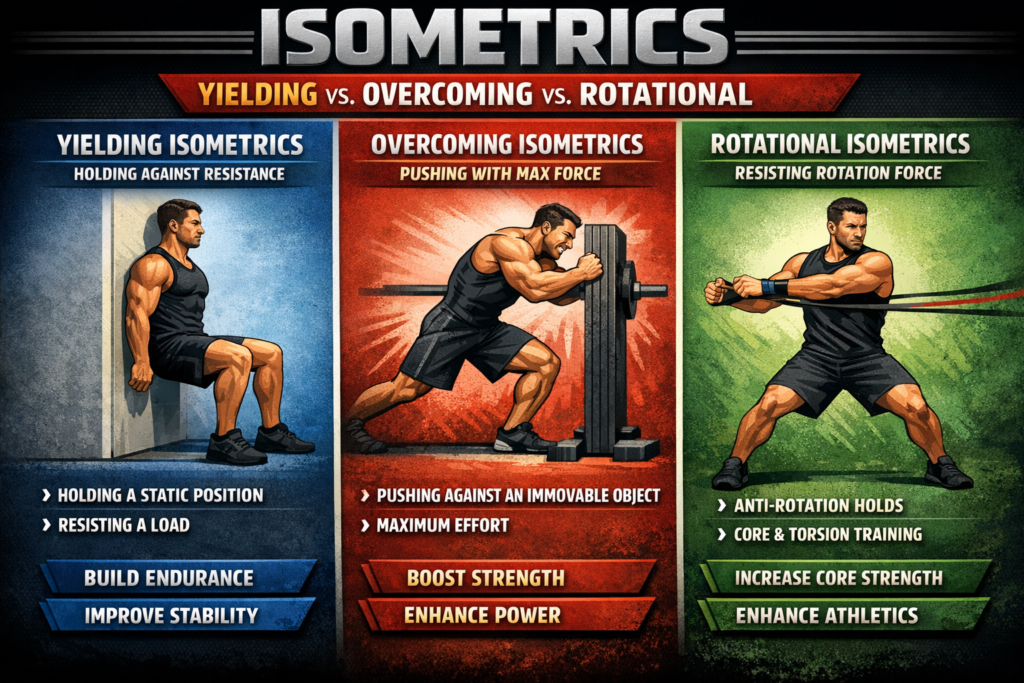
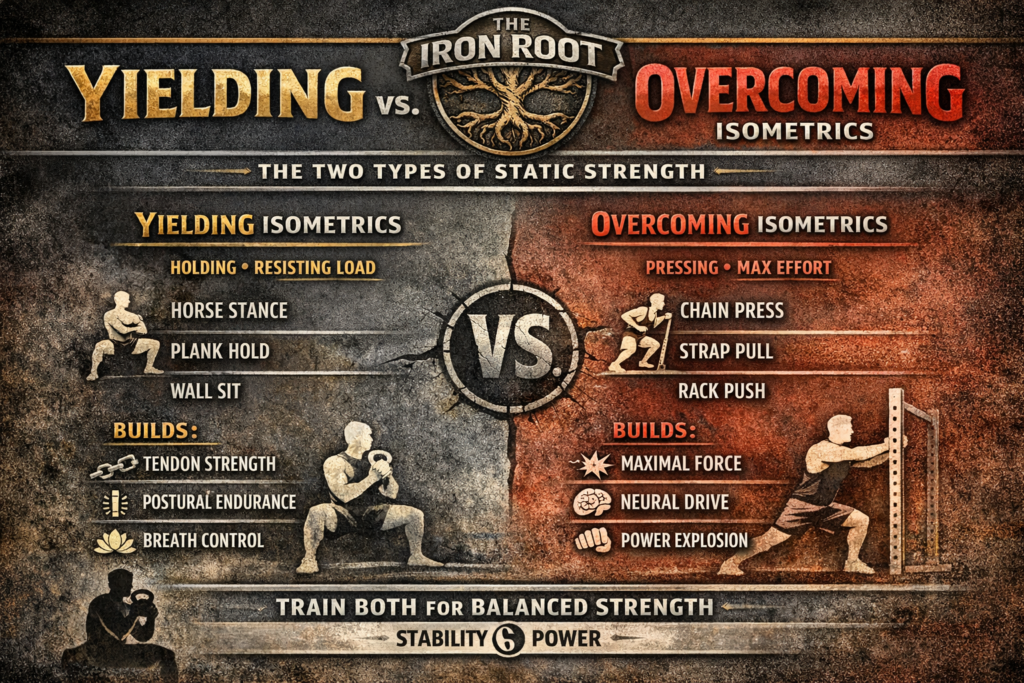
Yielding vs. Overcoming Isometrics: The Two Types of Strength for Martial Artists

Yielding vs. Overcoming Isometrics: The Two Types of Strength for Martial Artists

There’s a reason isometric training has quietly become one of the most powerful tools for martial artists, grapplers, and fighters who want to develop real strength without destroying their joints.

But here’s something most people don’t realize:

Not all isometrics are the same.

In fact, there are two fundamentally different types of isometric training, and each one develops a completely different layer of strength.

These are known as:

Yielding Isometrics
Overcoming Isometrics

Understanding the difference between these two methods can completely change how you train.

Because when they’re used correctly, they develop the exact qualities that traditional martial artists valued most:

• structural integrity
• tendon strength
• breath control
• whole-body power

Let’s break them down.


Yielding Isometrics

The Foundation of Structural Strength

A yielding isometric is when you hold a position against gravity or load without allowing your posture to collapse.

You are resisting the force and refusing to give up the position.

In other words:

You yield to the load, but you do not break.

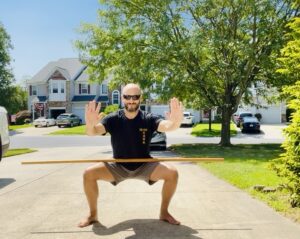
Examples include:

• horse stance holds
• planks
• side planks
• push-up holds
• goblet squat holds
• wall sits
• suitcase carries

In martial arts, these positions closely resemble traditional stance training or zhan zhuang standing practice.

They develop something that most modern strength programs ignore – structural endurance.

Instead of building strength through movement, you build strength by learning to maintain alignment under pressure.

And that produces several powerful adaptations.

Yielding Isometrics Build Tendon Strength

When you hold a position for time, the load transfers directly into the connective tissue.

That means you strengthen:

• tendons
• ligaments
• fascia chains

These tissues adapt slowly—but when they do, the strength becomes extremely durable.

This is why old martial artists could train for decades without breaking down.


Yielding Isometrics Train Breath Control

One of the most overlooked benefits of static holds is how they affect breathing.

When you hold tension for time, the nervous system must learn to regulate pressure and breathing simultaneously.

If your breath panics, your structure collapses.

Learning to breathe calmly under load builds the same composure needed for:

• grappling exchanges
• striking under pressure
• resisting takedowns


Yielding Isometrics Improve Posture and Alignment

Static holds teach the body how to:

• stack joints correctly
• distribute tension through the body
• root into the ground

This is the foundation of what many internal martial arts call connected power.


The Limitation of Yielding Isometrics

While yielding isometrics are incredible for building structure and endurance, they have one limitation.

They do not train maximum force production.

In other words:

They make you stable and durable—but not necessarily explosive.

That’s where the second type of isometric training comes in.


Overcoming Isometrics

The Hidden Method for Building Raw Power

An overcoming isometric occurs when you attempt to move an object that cannot move.

Instead of holding a position, you push or pull against an immovable resistance.

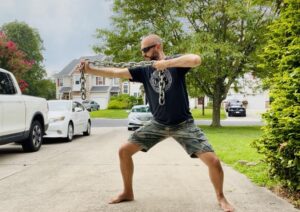
Examples include:

• pulling against straps or chains
• pushing against a wall
• rack pulls against safety pins
• belt squat pulls
• towel pulls in horse stance

In these exercises, the goal is to apply maximum force.

The object doesn’t move, but the nervous system behaves as if it should.

This creates an extremely powerful training effect.


Overcoming Isometrics Train Maximum Neural Recruitment

When you attempt to move an immovable object, the nervous system recruits as many muscle fibers as possible.

This dramatically increases strength.

Even though the object never moves, the body learns how to generate maximum contraction.


Overcoming Isometrics Build Explosive Power

These exercises train the ability to produce force quickly.

That makes them incredibly valuable for martial artists who want to improve:
• striking power
• grappling pressure
• pushing strength
• pulling strength


Overcoming Isometrics Strengthen Tendon Elasticity

Short bursts of maximal tension also increase the spring-like behavior of tendons.

This creates the elastic recoil responsible for powerful striking and throwing mechanics.


The Limitation of Overcoming Isometrics

Overcoming isometrics are extremely intense.

If they’re used too frequently or without proper structure, they can:

• fatigue the nervous system
• create excessive tension
• encourage breath holding

This is why the best systems combine them with yielding isometrics.


The Real Secret: Combining Both Methods

The most effective strength systems use both types of isometrics together.

Yielding isometrics build:

• structure
• endurance
• tendon durability
• breath control

Overcoming isometrics build:

• maximum force
• explosive strength
• neural recruitment
• elastic tension

In traditional martial philosophy, this combination represents the balance of:

Yin and Yang.

Yielding training stores potential.

Overcoming training releases it.

Together they build a body that is both stable and powerful.


How I Teach These Methods

Inside my training programs, these two methods are integrated into a progressive system.

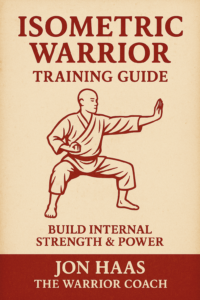
The Isometric Warrior Training Guide

This program teaches the foundations of structural strength through carefully selected yielding isometrics.

You will learn how to build:

• strong connective tissue
• stable posture
• calm breathing under load

👉 Learn more about The Isometric Warrior Training Guide here


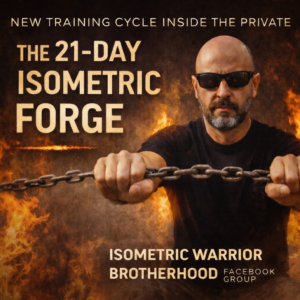
The 21-Day Isometric Forge

Inside the private Isometric Warrior Brotherhood, we take the next step and begin integrating overcoming isometrics.

These exercises introduce:

• diagonal force
• rotational tension
• strap-based resistance
• martial power development

Access to the Forge is available as a free bonus program when you join the Brotherhood through the Isometric Warrior Training Guide.


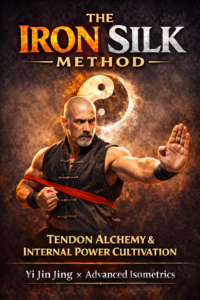
The Iron Silk Method

For advanced practitioners, the Iron Silk Method combines traditional tendon-changing exercises from the Yi Jin Jing with advanced isometrics to develop deep structural power.

This program integrates:

• breath training
• tendon elasticity
• structural force transmission

👉 Learn more about The Iron Silk Method here


Final Thoughts

Many martial artists spend years training technique while neglecting the body that must perform it.

The result is predictable:

Skill increases.

But power becomes inconsistent.

By combining yielding and overcoming isometric training, you develop something different:

A body that can express technique effortlessly.

Stable.

Elastic.

Calm under pressure.

The way martial artists were meant to move.


Jon Haas
The Warrior Coach

The Five Pillars of the Iron Body

How Martial Artists Build Lifelong Strength, Power, and Durability

There is a quiet truth that most martial artists eventually discover.

Technique alone is not enough.

You can know hundreds of techniques, understand strategy, and have decades of experience… but if the body itself is not developed correctly, that knowledge cannot be fully expressed.

The greatest martial artists throughout history understood something very important:

They didn’t just train techniques.

They trained the body itself.

They forged a body that was:

• elastic
• structurally aligned
• internally powerful
• externally durable
• and capable of integrating all these qualities into real movement

This type of body is what I like to call The Iron Body.

And over the decades, after studying internal martial arts, strength training, Qigong, and traditional conditioning methods, I’ve come to understand that the martial body develops through five essential pillars.


The Five Pillars of the Iron Body

Every powerful martial artist develops five core qualities:

  1. Elasticity

  2. Structure

  3. Pressure

  4. Durability

  5. Integration

When these pillars are trained together, the body becomes both powerful and resilient.

Let’s look at each one.


Pillar One: Elasticity

The Spring of the Body

Muscular strength is useful, but true martial power comes from something deeper.

The body must behave like a bow.

When tendons and connective tissue become elastic, they store energy during movement and release it explosively.

This is why skilled martial artists often appear relaxed yet generate tremendous force.

They are not relying on muscular tension.

They are using elastic power.

Training methods that develop elasticity include:

• Yi Jin Jing tendon training
• structural isometrics
• slow movement exercises
• controlled connective tissue loading

This is exactly the focus of my Iron Silk Method program.

Iron Silk is designed to restore the elastic connective tissue qualities that allow martial power to feel effortless.

When elasticity develops, many practitioners notice:

• strikes feel heavier
• movements become smoother
• the body feels springy instead of stiff

Elasticity is the engine of martial power.


Pillar Two: Structure

The Frame That Carries Force

Power does not come only from the muscles or tendons.

It must travel through the body.

Structure is what allows force to move efficiently through the skeleton into the ground.

When structure is correct:

• the body becomes stable
• pressure flows through the frame
• muscles remain relaxed

When structure collapses, power disappears.

This is why many internal martial arts emphasize standing practice.

Standing training teaches the body to align:

• feet
• hips
• spine
• shoulders
• head

When these elements are stacked correctly, the body becomes capable of carrying tremendous force without strain.

This is the focus of Zhan Zhuang training.

Zhan Zhuang develops:

• posture
• root
• internal connection
• relaxed strength

Over time, standing practice creates a body that feels heavy and stable under pressure.


Pillar Three: Pressure

Breath-Driven Internal Power

Breathing is far more than a relaxation tool.

In traditional martial arts, breath is used to create internal pressure.

This pressure stabilizes the body and fuels movement.

Practices that develop internal pressure include:

• dantien breathing
• whole-body breathing
• compression and expansion drills

When breath and structure work together, something powerful happens.

The body begins to move as one connected unit.

This type of breathing is a key component of both Iron Silk and Martial Qigong training.


Pillar Four: Durability

The Armor of the Body

Elasticity creates power.

Structure directs power.

Breath fuels power.

But the body must also be able to handle power.

That’s where durability comes in.

Durability refers to the strengthening of:

• bones
• tendons
• muscles
• skin
• connective tissue

Historically this was developed through hard Qigong training.

Practices included:

• static posture strength training
• tendon conditioning
• iron body methods
• breath-powered tension

This is exactly what is taught inside my Martial Qigong course.

Martial Qigong develops the external strength and durability that allows martial artists to remain strong and resilient as they age.

Without durability, elasticity becomes fragile.

With durability, the body becomes capable of absorbing and delivering force safely.


Pillar Five: Integration

Turning Training Into Martial Power

The final pillar is integration.

Integration is where everything comes together.

Elasticity, structure, breath, and durability must eventually become one coordinated system.

This is what allows martial artists to move naturally and generate power without thinking.

Integration is developed through:

• slow martial movement
• striking mechanics
• grappling pressure drills
• standing meditation

At this stage, the body begins to express power effortlessly.

Many practitioners describe this as:

• heavy hands
• relaxed strength
• effortless issuing

This is the stage where training becomes true martial skill.


The Foundation of Everything: Daily Practice

All five pillars rest on one essential foundation.

Daily practice.

The martial body is not built through occasional effort.

It is built through consistent, intelligent training over time.

Even short daily practice sessions can create profound changes in the body.

A simple daily structure might include:

Standing practice 
Iron Silk tendon training
Breathing exercises
Martial Qigong conditioning

Over weeks and months, these practices gradually transform the body.

This is how martial artists develop strength that lasts decades instead of years.


Bringing It All Together

When the five pillars are trained together, the body begins to change in remarkable ways.

Elastic connective tissue creates explosive power.

Structure carries force efficiently.

Breath generates internal pressure.

Durability protects the body.

Integration turns all of this into martial ability.

This is the essence of The Iron Body Protocol.

And it is exactly what my training programs are designed to develop.

Iron Silk Method builds elasticity and tendon power
Martial Qigong develops durability and external strength
Zhan Zhuang standing practice creates structure and internal connection

Together, they form a complete system for building a powerful, resilient martial body.


Train for the Long Path

Martial arts are not just about fighting.

They are about developing the body and mind over a lifetime.

When you train the five pillars consistently, the goal is simple:

To become stronger, healthier, and more capable every year.

Not weaker.

Not slower.

But better.

That is the path of the Iron Body.

Train with intent.

— Jon Haas
The Warrior Coach